
training
The Mind-Muscle Connection: Andy’s 6-Week Update
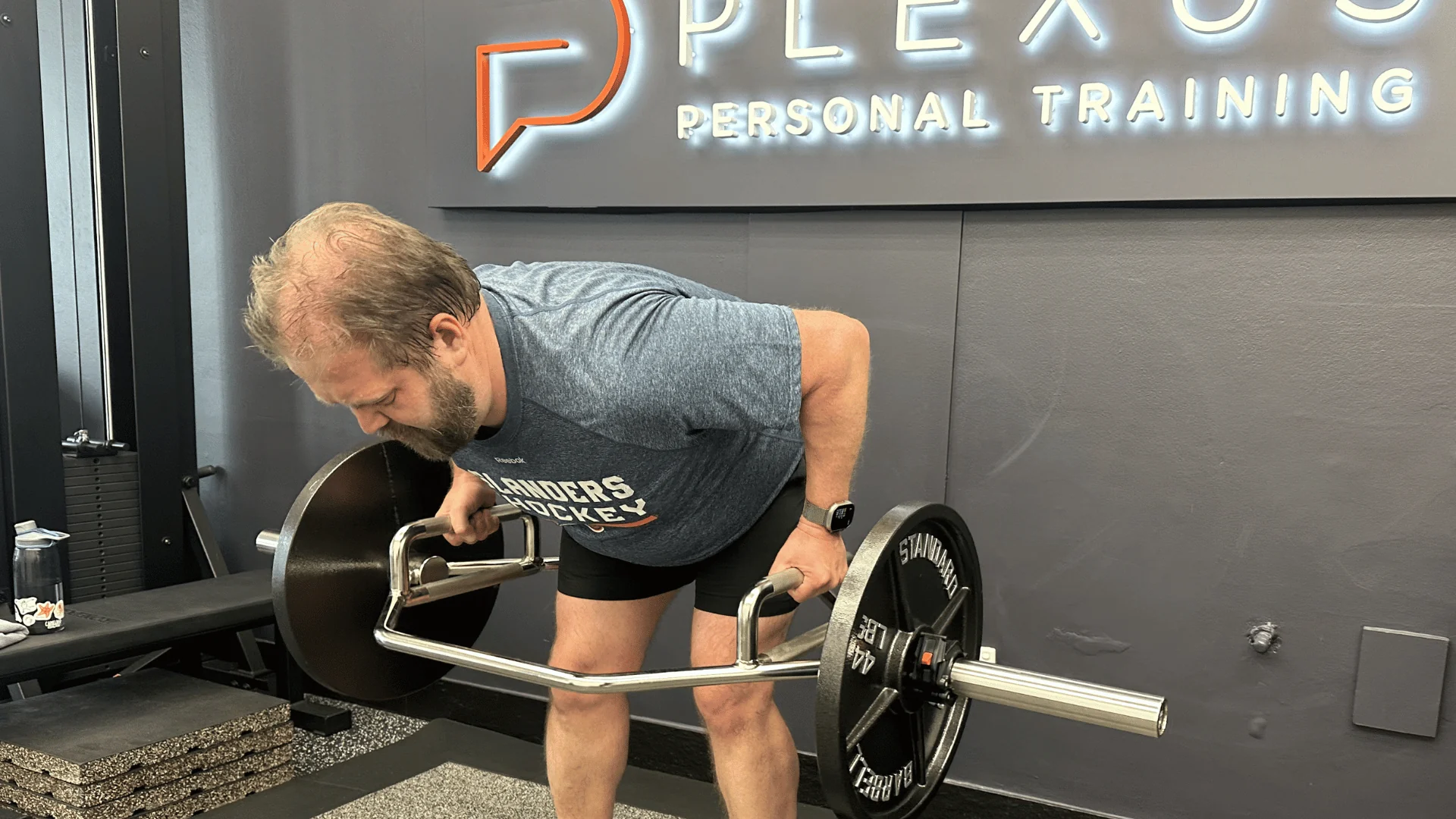
6 weeks ago, Andy walked into Plexus Personal Training, Roseville Chase for the first time. Nervous. Uncertain. Quietly convinced he probably didn’t belong in a gym.
We wrote about those first 30 days – the neural adaptation, the dead hang he held for 31 seconds when he expected 10, the soreness that had him walking downstairs like a man twice his age.
That post was about what happens to your body in the first month of strength training.
This one is about something different – the mind-muscle connection. Something that happens after the soreness fades and the movements start to feel familiar. Something Andy put into words better than most people manage.
The moment it stops feeling like something you’re doing to your body – and starts feeling like something you’re doing with it.
Something Had Shifted
Andy sent me a message this week. Unprompted. No questions asked – just a reflection on where he’s at.
I’ll let him tell it.
“The biggest shift is probably how connected I feel to movements. My posture is better – I don’t grab my back when I bend down, and I’m not just brute-forcing movements at the gym anymore. I can actually feel what I’m doing during lifts and exercises, and my form feels more controlled and deliberate.”
That’s not a fitness outcome. That’s a nervous system outcome. And it’s one of the most significant things that happens in the first couple of months of proper strength training – yet almost nobody talks about it.
“I’m feeling muscles that I don’t know about – and there is a brain-body connection to new places. I’m deliberately turning on my core and bracing before I lift, rather than horsepowering my way through a set. I focus on breathing – not just survival.”
Horsepowering through a set. I’m keeping that phrase. It’s exactly what most people do when they first start training – and it’s exactly what stops working the moment you get serious about progress.
What George Sees From the Other Side
I asked George – Andy’s trainer at Roseville Chase – what’s actually happening when a client reaches this point. When they go from going through the motions to genuinely feeling what’s working.
“They can feel what’s working and why because of cueing and activation – priming the right muscles before a movement, selecting exercises that address specific weaknesses in their movement patterns. When a client starts listening to their body and giving me feedback on what they’re feeling during a drill, that’s when progression accelerates. And the confidence that comes with it? That’s the nervous system adapting. They’re recruiting more motor units, creating more force, and their brain is finally catching up to what their body is capable of.”
Motor unit recruitment is the technical term for what Andy described as a brain-body connection to new places. Your muscles are made up of thousands of individual fibres, each controlled by a motor neuron. In the early weeks of training, your brain is essentially learning which switches to flip and in what order. The more you train a movement pattern, the more efficiently your nervous system recruits the right fibres at the right time.
The result is what Andy’s experiencing – movements that feel controlled rather than forced. Strength that feels intentional rather than accidental.
The Numbers Are Moving Too
The mind-muscle connection isn’t just a feeling. It shows up in the data.
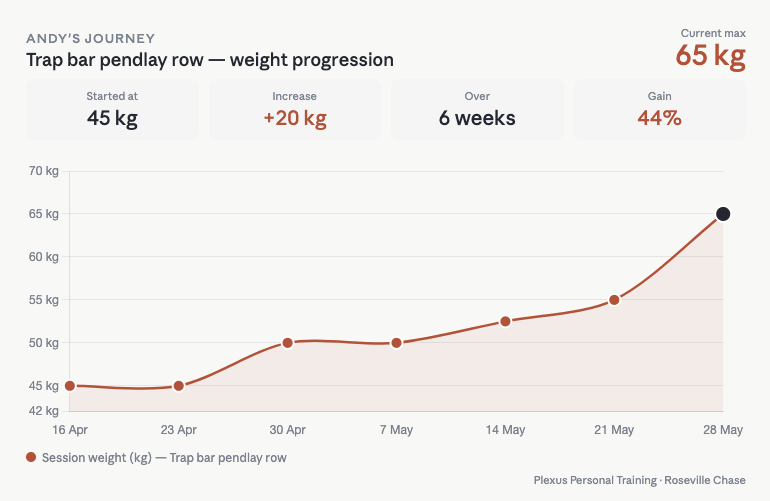
Andy’s trap bar pendlay row has gone from 45kg to 65kg in six weeks – a 44% increase. That’s not brute force. That’s what happens when technique improves alongside load. When the nervous system is doing its job properly, you can move more weight with less wasted energy.
He’s also getting close to completing four sets of eight bench press reps unassisted – something that wasn’t possible in week one. He mentioned it came with a side of frustration.
“My bench press numbers haven’t really gone up yet. I’m getting much closer to 4×8 reps without help, which is progress – but part of my brain still just likes seeing bigger numbers. Again, I need to slow down, trust George and not wreck myself.”
This is exactly the competitive instinct that makes someone a good training client – and exactly the instinct that needs managing. George is holding the line deliberately. Progress that outpaces technique is how people get injured. Progress that follows technique is how people keep training for years.
The Part Nobody Admits
Beyond the data, Andy said something that I think matters more than any number on a chart.
“I don’t want to admit it – as most of my friends wouldn’t believe it – but I’m getting to the point where I’m actually enjoying this now. It doesn’t feel like a chore. It’s a bit of self care that is becoming part of the rhythm of my week.”
This is the thing about the mind-muscle connection that nobody tells you. It doesn’t just change how you train. It changes how you think about training.
When you can feel what’s working, when you understand why a movement feels different today than it did last week, when you have something concrete to compete against – your own previous numbers, your own previous form – the motivation shifts. It stops being external and starts being intrinsic.
Andy came in six weeks ago worried he didn’t belong in a gym. He’s now looking forward to sessions. He’s tracking his numbers. He’s quietly smug about his dead hang time. He’s wearing work pants he couldn’t do up in April.
“My belt has gone down a hole, and a pair of work pants that were always too tight around the gut, hips and arse are now fitting properly again. I’ve been wearing them to work this week – and this for me is a real reminder of the progress I’ve made.”
A belt notch and a pair of trousers. Not a DEXA scan, not a before-and-after photo. Just a concrete, daily reminder that something is working.
That’s what 30 days looks like when you show up consistently and trust the process.
What This Means If You’re Still Thinking About Starting
The mind-muscle connection isn’t something you develop before you walk through the door. It’s something that develops because you walked through the door.
You don’t need to know what a motor unit is. You don’t need to understand proprioception or neural adaptation. You just need to show up, let a good trainer cue you properly, and give your nervous system the repetitions it needs to figure things out.
The first sessions feel like brute force because they are. That’s normal. It means the wiring is being built.
By week four or five – if Andy’s experience is any guide – it starts feeling like something else entirely.
Andy’s journey continues at Plexus Personal Training, Roseville Chase. His three-month DEXA rescan is the next milestone – we’ll share those results when they come.
If you’re ready to start your own first 30 days, book a free strategy call with our team at Pymble or Roseville Chase.
Book your free strategy call here